Understanding commercial solar ROI 2026 UK is no longer just a sustainability discussion. For many organisations across Hampshire and the wider South of England, it is a capital allocation decision competing with other investments.
Energy prices remain structurally higher than pre 2021 levels. Grid volatility, ESG reporting pressures, and rising operational costs mean business owners, property managers, schools and farms are actively asking:
- What is the commercial solar payback period UK in 2026?
- Is commercial solar worth it 2026?
- What are realistic business solar savings UK?
- What does a commercial solar installation cost UK today?
This guide breaks down the numbers clearly and practically, using real world system sizes and current UK conditions.
The 2026 UK Energy Context for Commercial Sites
The UK continues its transition towards net zero under the framework set by the UK Government. According to Department for Energy Security and Net Zero, electrification and on site renewable generation are central to decarbonisation targets.
At the same time:
- Typical commercial electricity rates in 2026 range between 22p and 35p per kWh depending on contract and load profile.
- Standing charges and capacity charges are rising for many larger sites.
- ESG reporting is increasingly embedded within procurement frameworks and public sector tenders.
- Businesses exporting power may receive Smart Export Guarantee payments via suppliers such as Ofgem regulated schemes.
For organisations with large daytime consumption, solar PV directly offsets high grid rates. This is where the strongest return on investment lies.
What Is Commercial Solar ROI?
Commercial solar ROI measures the financial return generated by a solar PV system compared to its capital cost.
It is typically assessed through:
- Payback period in years
- Internal Rate of Return
- Net Present Value
- Lifetime savings over 25 years
For most decision makers, the commercial solar payback period UK remains the primary metric.
Typical Commercial Solar Installation Cost UK 2026
Installed costs vary depending on roof type, access, grid constraints and system size. As a guide for 2026:
| System Size | Typical Cost Range | Cost per kWp (approx) |
|---|---|---|
| 30 kWp | £16,800 to £24,300 | £560 to £810 |
| 50 kWp | £27,000 to £39,500 | £540 to £790 |
| 100 kWp | £52,000 to £77,000 | £520 to £770 |
| 250 kWp | £125,000 to £187,500 | £500 to £750 |
Larger systems benefit from economies of scale. Roof mounted systems are usually more cost effective than ground mounted installations due to reduced civil works.
These figures assume standard commercial rooftops such as trapezoidal sheet, flat roof ballast systems or agricultural buildings.
Example: 100 kWp Commercial System Financial Breakdown
Let us consider a Hampshire based manufacturing site installing a 100 kWp system.
System Assumptions
System size: 100 kWp
Annual generation: 90,000 to 100,000 kWh
Installed cost: £60,000
Electricity import rate: 28p per kWh
On site usage: 80 percent
Export rate: 5p per kWh
Annual Financial Performance
Self consumption:
- 80,000 kWh x 28p = £22,400 saved
Export income:
- 20,000 kWh x 10p = £2,000 earned
Total annual benefit:
- Approx £24,400 per year
Payback Period
£100,000 divided by £24,400 = 4.1 years
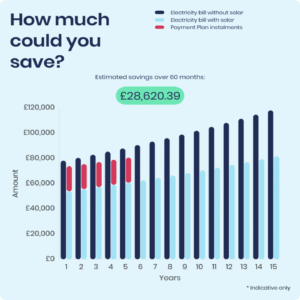
After payback, electricity is effectively generated at a marginal cost far below grid prices for the remaining system life. With panel warranties commonly at 25 years, lifetime net savings could exceed £400,000 depending on tariff movements.
This is why commercial solar ROI 2026 UK figures are attracting serious board level attention.
Commercial Solar Payback Period UK by Sector
Different sectors see different results
Farms and Agricultural Sites
- High daytime usage
- Large roof areas
- 50 to 250 kWp common
Typical payback: 3.5 to 5 years
Agricultural sites often benefit from strong self consumption, especially with refrigeration or grain drying.
Schools and Educational Buildings
- Strong daytime load
- Public sector ESG pressure
Typical payback: 4 to 6 years
Solar helps stabilise long term operating budgets.
Industrial and Manufacturing
- Continuous machinery loads
- High energy intensity
Typical payback: 3 to 5 years
Often one of the strongest ROI cases.
Commercial Property Landlords
- Tenant billing structure matters
- Often linked with EPC improvement
Payback varies based on lease agreements.
Is Commercial Solar Worth It 2026?
For most high consumption daytime businesses, the answer is increasingly yes.
However, there are conditions where ROI weakens:
- Low daytime electricity usage
- Limited roof space
- Major grid upgrade costs
- Structural roof remediation required
A proper feasibility study is essential.
Solar panels for businesses UK deliver the best results where:
- Electricity usage aligns with solar generation hours
- Energy costs are above 20p per kWh
- The business has long term site stability
Business Solar Savings UK Over 25 Years
Solar PV systems degrade slowly, typically 0.4 to 0.5 percent per year.
A 100 kWp system producing 95,000 kWh per year initially may still produce around 85,000 kWh in year 25.
Assuming electricity prices average 25p over the period:
95,000 kWh x 25 years x 25p
= £593,750 gross value of electricity
Even accounting for degradation and maintenance, net lifetime savings frequently exceed four to six times the original capital cost.
That is a significant capital multiplier compared with many alternative investments.
Impact of Battery Storage on Commercial ROI
Battery storage can improve ROI in specific scenarios:
- Where peak demand charges apply
- Where flexible half hourly tariffs create arbitrage opportunities
- Overnight usage or varying demand profiles
However, batteries add capital cost. For many businesses, solar first and battery second remains the most financially prudent approach.
Capital Allowances and Tax Benefits
The UK capital allowance framework allows businesses to offset qualifying plant and machinery investments against taxable profits.
Solar PV systems typically qualify under plant and machinery rules. This can significantly improve effective ROI when structured correctly.
Professional tax advice is recommended to model this accurately.
Risk Factors Decision Makers Should Consider
A financially analytical approach requires acknowledging risk:
- Electricity price volatility
- Future export tariff reductions
- Grid connection constraints
- Roof lifespan alignment
At Solar Voltaics, feasibility assessments include load profile analysis and generation modelling to reduce uncertainty.
Strategic Benefits Beyond Direct ROI
While this article focuses on commercial solar ROI 2026 UK from a financial perspective, non financial value also matters:
- Improved EPC ratings
- ESG reporting improvements
- Stronger tender positioning
- Visible sustainability commitment
According to Carbon Trust, on site renewable generation can significantly reduce Scope 2 emissions for organisations.
For some sectors, this translates into procurement advantage.
Practical Example: 50 kWp System for a School
Installed cost: £55,000
Generation: 45,000 kWh per year
Import rate: 26p per kWh
Self consumption: 90 percent
Annual savings:
40,500 kWh x 26p = £10,530
Export:
4,500 kWh x 10p = £450
Total benefit:
£10,980 per year
Payback:
Approx 5 years
After year 5, annual budget relief of around £11,000 for the remaining system life.
How to Evaluate Your Own Site
Decision makers should review:
- Annual electricity consumption
- Daytime load profile
- Roof size and orientation
- Existing contract rates
- Future site plans
A detailed site survey combined with half hourly data analysis gives the clearest ROI picture.
Frequently Asked Questions
What is the average commercial solar payback period UK in 2026?
Most well sized systems achieve payback between 3.5 and 6 years, depending on electricity rates and self consumption levels.
Is commercial solar worth it 2026 for small businesses?
For businesses using more than 20,000 kWh per year with strong daytime usage, solar can still provide attractive returns, often under 6 years.
How much does a commercial solar installation cost UK?
Costs typically range from £800 to £1,300 per kWp depending on size, roof type and complexity.
How long do solar panels for businesses UK last?
Most panels carry 25 year performance warranties and often operate effectively beyond this period.
Can commercial solar reduce EPC ratings?
Yes. On site renewable generation can improve building energy performance, which may support compliance and asset value.